
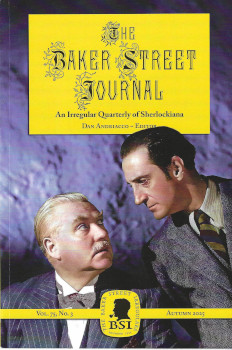
The Autumn 2025 Baker Street Journal includes these articles:
The Editor’s Gas-Lamp.
Discovery: Ettie Stettheimer, The First Lady of Sherlockian Parody
by Daniel L. and Eugene B. Friedman.
Rolling on the River in The Sign of the Four
by Bruce Harris.
It Wasn’t the Band: The Use of “Gypsies” in the Canon
by Anna Brindisi Behrens.
A Study in Solecisms
by Damian Thompson.
Rathbone, Bruce, and the BSI (Part I)
by Jerry Kegley.
Sherlock Holmes the Stoic
by Erik Deckers and StoicDan Lampert.
The Detective and His Strad
by Charles Blanksteen.
Gender Bender: Reimagining Holmes and Watson
by Paul Bishop.
Oscar Wilde and the Aesthetic Sherlock Holmes
by Ron Levitsky.
Carbonari or Camorra?
by George Skornickel.
The Commonplace Book.
Baker Street Inventory.
Letters to Baker Street.
Sherlock Holmes Klubben I Danmark’s 75th Anniversary Dinner.
“Stand with me here upon the terrace…”
Whodunit?
* * *
The Editor’s Gas-Lamp
” … the one fixed point in a changing age.”
by Dan Andriacco, Editor

Almost everyone who is a self-described Sherlockian is familiar with Vince Starrett’s immortal sonnet “221B.” For more than 60 years I have been enamored of another Starrett work with the same closing line. It’s the final paragraph of “The Private Life of Sherlock Holmes” chapter in the book of the same name:
But there can be no grave for Sherlock Holmes or Doctor Watson … Shall they not always live in Baker Street? Are they not there this moment, as one writes? … Outside, the hansoms rattle through the rain, and Moriarty plans his latest deviltry. Within, the sea coals flame upon the hearth and Holmes and Watson take their well-won ease … So they still live for all that love them well: in a romantic chamber of the heart, in a nostalgic country of the mind, where it is always 1895.
That last line is so beautiful, so moving, so iconic–yet so untrue, both literally and metaphorically. Only five canonical adventures take place in 1895 and 22 of them take place later, according to a consensus of chronologists surveyed by Andrew Jay Peck and Leslie S. Klinger some years ago. Time moves ahead in the Canon.
More importantly, the spirit of the stories published later changes–and so does Holmes. The stories get more hard-boiled, and Holmes less so. Watson may be “the one fixed point in a changing age, but not Holmes. Anthony Boucher found the later Holmes so different that he wrote an essay called, “Was the Later Holmes an Imposter?”–and answered his own question in the affirmative. The early Holmes is mostly unemotional. The later Holmes cries in “The Three Garridebs,” “You’re not hurt, Watson? For God’s sake say that you are not hurt!”
Sherlock Holmes changes over time, as we all do. But whether in a hansom cab or driven by Watson in a Ford in “His Last Bow,” he always fascinates as we return to his adventures again and again.
The Editor’s Gas-Lamp, Autumn 2025, Vol. 75, No. 3
Learn More
Latest BSJ News & Issues (covers & contents)
FAQ- BSJ Frequently Asked Questions
Read a Free PDF of a Full Issue of the BSJ
About the BSJ (overview page)
 The Baker Street Irregulars